
A SOC evolves from a cost centre to a revenue centre for some CSPs

Contents
1. Executive summary
1.1 Summary of the methodology
1.2 Key results: a SOC can enable efficiency savings as well as generate new revenue
2. Introduction
2.1 Key objectives of the study
2.2 Methodology
2.3 Structure of the white paper
3. SOC definition and possible deployment models
4. Benefits from standalone SOC deployment: saves opex related to NOC and customer care and generates revenue
4.1 Introduction
4.2 Deploying a SOC can be a sound investment for many CSPs
4.3 A SOC has the capability to significantly reduce NOC- and customer-care-related opex for CSPs
4.4 A SOC can help a CSP to grow its revenue
4.5 There are other potential benefits that are yet to be validated in practice
5. Possible benefits from a centralised SOC deployment and barriers for commercialisation
5.1 Possible benefits of a regional and global centralised SOC
5.2 Barriers to the deployment of a centralised SOC
6. Evolution of SOCs in the context of operators’ digital transformation
6.1 CSPs are transforming their businesses to become digital service providers
6.2 A SOC can help CSPs to transform into DSPs
7. Evolution of SOCs in the context of network virtualisation
7.1 While CSPs’ NFV/SDN transformation is still in its infancy, most CSPs recognise the importance of virtualisation
7.2 A SOC is likely to provide CSPs with operational-level abstraction, a much needed ingredient of CSPs’ NFV/SDN transformation
8. Conclusions and recommendations
About the authors
About Analysys Mason
1. Executive summary
Analysys Mason has carried out a study on behalf of Huawei to examine the possible business case for investment by communications service providers (CSPs) into deploying service operations centres (SOCs). Key objectives of the study were to quantify the commercial benefits to a CSP of deploying a SOC, and discuss the evolution of SOCs in the context of CSPs’ efforts in network virtualisation and digital transformation.1.1 Summary of the methodology
We collected data for the study by conducting thorough desk research and interviewing five CSPs in Asia– Pacific and the Middle East, each at a different stage of deploying a SOC. During the interviews, we collected operational and financial data relevant to the return-on-investment (RoI) in a SOC and discussed with CSPs’ executives the evolution of SOCs in the context of CSPs’ network virtualisation and digital transformation efforts.1 To quantify the business benefits of a SOC, Analysys Mason built a ten-year RoI model. We used the RoI model to run a range of sensitivity analysis, such as the cost of capital, reflected in the weighted average cost of capital (WACC), and the year in which the SOC is deployed.1.2 Key results: a SOC can enable efficiency savings as well as generate new revenue
Our research suggests that, by investing in a SOC, a CSP can break even in about three years and the RoI can be between 15% and 25% at the end of ten years. On average, about 70% of the total value created by the SOC in ten years after its deployment, will come from efficiency savings enabled by the SOC. The remaining 30% of the total value created by the SOC deployment will, on average, come from additional revenue generated attributable to the deployment of the SOC. Figure 1.1. shows that most of the efficiency savings achieved through a SOC, over a period of ten years upon its deployment, will come from lower mean time to resolution of faults.
Figure 1.1: Breakdown of value created by the SOC over a ten year period [Source: Analysys Mason, 2016]

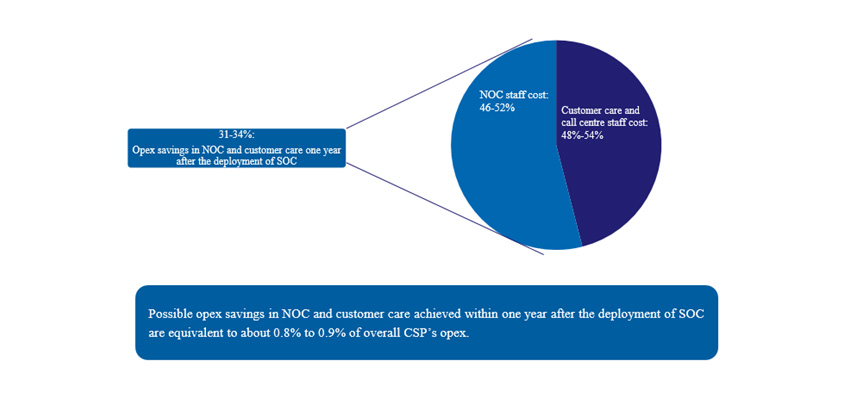
Our research also suggests that efficiency savings were quick wins for some CSPs and were pronounced from the inception of the SOC deployments. In fact, some CSPs achieved over 30% of savings in customer care and NOC related opex only one year after the deployment of the SOC. In Figure 1.2. we show that these opex savings in the first year of deployment can be attributed to the lowering of NOC and customer care and call centre staff costs. Please note that we provide ranges in the pie chart (46%-52% and 48% -54%) as some CSPs saved more on NOC, while others on customer care and call centre staff costs.
Figure 1.2: Customer-care and NOC-related opex savings one year after the deployment of the SOC [Source: Analysys Mason, 2016]
In addition to the above key findings of our research, we tested several other hypotheses related to a SOC deployment and evolution. Some of these hypotheses were validated through our research, while others have yet to be validated in practice. All our findings are summarised in Figure 1.3 and described briefly below.
Figure 1.3: Key hypotheses and the extent to which they were validated by our research [Source: Analysys Mason, 2016]
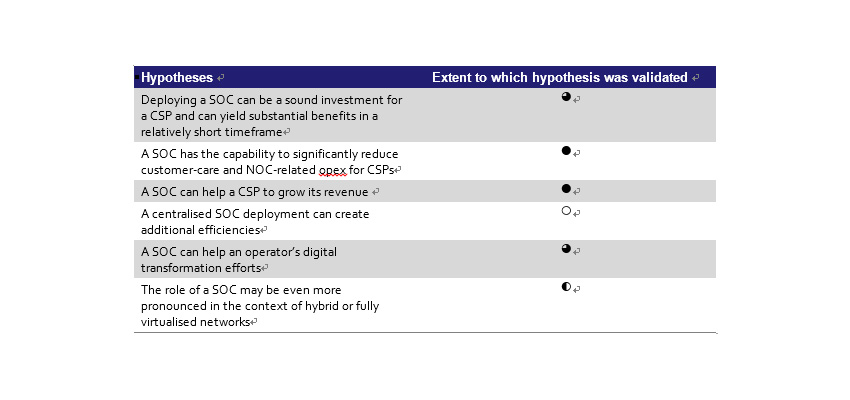
●strongly validated ● largely validated ●partially validated ● not validated
Hypothesis 1: Deploying a SOC can be a sound investment for a CSP and can yield substantial benefits in a relatively short timeframe
Finding 1: According to our analysis, by investing in a SOC, a CSP can break even in about three years and the RoI can be between 15% and 25% at the end of ten years. Over the ten-year period, about 70% of the value created by the SOC comes from efficiency savings associated with opex related to customer care and NOC, and about 30% can be attributed to the revenue uplift created by the SOC. In addition, there may be other benefits from SOC deployment which we were not able to quantify at this point yet due to the infancy of the SOC deployment cases studied. For instance, a SOC could have a transformational effect on CSPs, breaking down organisational barriers and fostering inter-departmental collaboration. Moreover, a SOC could also generate additional savings in marketing, and help with Net Promoter Score (NPS) improvement and prioritisation of investment.
Hypothesis 2: A SOC has the capability to significantly reduce customer-care and NOC-related opex for CSPs in a short period of time
Finding 2: According to our analysis, a CSP could realise opex savings of about 30% - 35% in customer care and the NOC one year after a SOC deployment: most of these savings come from the headcount optimisation.
Hypothesis 3: A SOC can help a CSP to grow its revenue
Finding 3: Revenue uplift can be achieved through targeted marketing, new service and product designs, and churn reduction. From the total value created by a SOC deployment over a ten year period, on average, about 30% can be attributed to additional revenue generated thanks to the deployment. However, this percentage can vary from 20% to above 50% for individual CSPs. In contrast to efficiency savings that can be realised quite quickly, revenue uplift enabled by a SOC is usually realised several years after the deployment. It should be noted that for the most promising revenue uplifts CSP case we examined in this research, the CSP was faced with opportune market dynamics where it had plenty of 3G ready subscribers still using 2G services. These subscribers were effectively and rapidly migrated to 3G services via targeted marketing campaigns enabled by the SOC.
Hypothesis 4: A centralised SOC deployment can create additional efficiencies for a CSP
Finding 4: While we are aware of CSPs’ increasing interest in a centralised SOC deployment, we were unable to validate the benefits from a centralised SOC in practice. The concept of a centralised SOC is in its infancy, and while we expect that SOC centralisation is the next logical step in CSPs’ customer experience management (CEM) efforts, we do not yet have enough evidence to make such a claim with a high level of certainty. It is our opinion that regional centralised SOCs (within the borders of a single large country) are a more feasible next step for CSPs.
Hypothesis 5: A SOC can help an operator’s digital transformation efforts
Finding 5: Network operations centres (NOCs), as they stand today, have too narrow a remit in the new digital economy and the new service complexity, new types of customers and new value chains that it may bring about. SOCs have the potential to fill this gap.
As CSPs move towards becoming digital service providers (DSPs), they will have to provide even better customer experience to their clients, and SOCs have the potential to help them in this task by monitoring the quality of the digital interaction with customers, as well as the usage of, and customers’ preference for the new digital economy services. A SOC can be the nerve centre that discovers new revenue opportunities in near real time during the process of digital transformation.
Hypothesis 6: The role of a SOC may be even more pronounced in the context of hybrid or fully virtualised networksFinding 6: Some CSPs we talked to recognise that abstraction is key to the success of virtualisation; and SOCs provide an operational-level abstraction, enabling CSPs to focus on quality of experience independent of the underlying infrastructure. At the same time, other CSPs we interviewed have not even entered the infancy stage of unable to comment on the implications for their SOCs.
More information is available, if you would like to learn more please contact your Huawei Local Service Solutions Team. Thank You!